Introduction
A sore throat can turn an ordinary day into a stressful guessing game. Is it just a cold, allergies, dry air, or something that needs antibiotics?
An at home strep test can feel like a quick answer when swallowing hurts, fever appears, and you want clarity without waiting in a clinic. These tests are designed to look for group A strep bacteria, the common cause of strep throat, but the result is only one part of the decision.
This matters because strep throat is bacterial, while many sore throats are viral. Antibiotics help confirmed strep, but they do not help common viral sore throats. The CDC says patients with clear viral symptoms usually do not need strep testing, while confirmed group A strep should be treated with antibiotics.
In this guide, you’ll learn how an at home strep test works, when it may help, when it can mislead you, and what to do after a positive or negative result.
What Is an At Home Strep Test?
An at home strep test is a rapid test kit used with a throat swab to check for signs of group A Streptococcus bacteria. These bacteria can cause strep throat, a painful throat infection that often needs antibiotics.
Most rapid strep tests are antigen tests. They look for pieces of the bacteria in a sample taken from the back of the throat and tonsil area. Many rapid tests can show results within minutes, while a throat culture usually takes longer but may detect infections that rapid tests miss.
In simple words, the test tries to answer one question: “Is group A strep likely present in this throat sample?”
That sounds simple, but the real-life answer depends on symptoms, swab quality, test quality, age, and whether a follow-up culture is needed.
How Strep Throat Usually Feels
Strep throat often comes on suddenly. A person may feel fine one day and wake up with sharp throat pain the next morning.
Common signs can include:
- Sudden sore throat
- Pain when swallowing
- Fever
- Red or swollen tonsils
- White patches or streaks on tonsils
- Swollen lymph nodes in the neck
- Headache or stomach pain, especially in children
Mayo Clinic lists quick-onset throat pain, painful swallowing, swollen tonsils, white patches, and tiny red spots near the back of the mouth among possible strep symptoms.
However, cough, runny nose, hoarseness, and mouth ulcers often point more toward a viral infection. That is why testing everyone with a sore throat is not always useful.
How an At Home Strep Test Works
Most kits use a throat swab, small tube, test strip or cassette, and liquid reagents. The swab collects material from the tonsils and back of the throat.
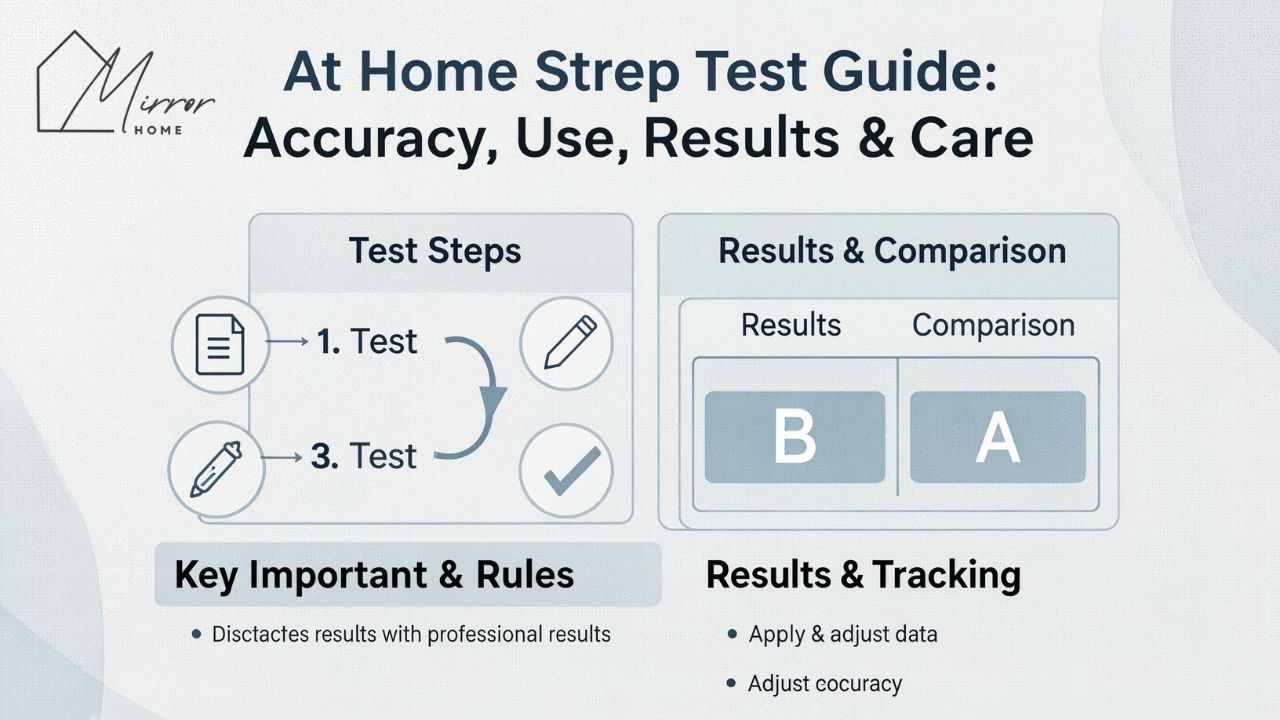
The usual process looks like this:
- Wash your hands.
- Open the sterile swab without touching the tip.
- Swab both tonsils and the back of the throat.
- Avoid touching the tongue, cheeks, teeth, or lips.
- Place the swab into the test solution.
- Add drops to the test cassette or dip the strip.
- Read the result within the time window listed in the instructions.
The hardest part is not the chemistry. It is collecting a good throat sample. A weak or shallow swab can cause a false negative, especially if the person gags, pulls away, or the swab touches the tongue more than the tonsils.
Accuracy, False Results, and Limits
An at home strep test may be useful, but it is not perfect. Rapid antigen tests are fast, but throat cultures can find some infections rapid tests miss. CDC notes that throat culture sometimes detects group A strep when a rapid test does not.
A positive rapid test is often treated as strong evidence of strep, especially when symptoms fit. A negative test is trickier. The CDC recommends confirming a negative rapid antigen test with a throat culture in symptomatic children aged 3 years or older.
There is another important point: many rapid strep tests sold or distributed in the U.S. are intended for professional or laboratory use. One FDA-cleared Strep A rapid test document states that negative results should be confirmed by culture and that the test is intended for professional and laboratory use only.
That does not mean every home-use situation is unsafe, especially when guided by telehealth or a clinician. It does mean you should be careful about buying random kits online and treating the result as final.
When to Use a Test at Home
A home test may make sense when symptoms look like strep and you have a reliable kit or clinician-guided testing option.
It may be reasonable to consider testing when there is:
- Sudden sore throat without cough
- Fever
- Swollen neck glands
- Red or swollen tonsils
- White patches on the tonsils
- Known exposure to someone with confirmed strep
Testing may be less helpful when symptoms clearly look viral, such as cough, runny nose, hoarseness, watery eyes, or mouth sores.
Real-life example: if your child has fever, no cough, swollen neck glands, and a classmate recently had strep, testing makes more sense. But if your child has a runny nose, cough, sneezing, and mild throat irritation, a viral cold is more likely.
How to Use a Home Strep Test Safely
Read the instructions before opening anything. It sounds obvious, but rapid tests can be sensitive to timing, liquid drops, and result-window rules.
Practical safety tips:
- Check the expiration date.
- Use clean hands and a clean surface.
- Do not reuse swabs or test strips.
- Swab the tonsils and back of the throat properly.
- Read the result only during the approved time window.
- Take a clear photo of the result if using telehealth.
- Do not start leftover antibiotics based on a home result.
- Contact a clinician for children, severe symptoms, or uncertain results.
One common mistake is reading the result too late. A faint line after the reading window may not be valid. Another mistake is assuming a negative result means “definitely not strep.”
What Positive and Negative Results Mean
Positive Result
A positive result means the test detected signs of group A strep in the throat sample. You should contact a healthcare provider, especially if antibiotics are needed.
Strep throat is treated with antibiotics when confirmed. CDC guidance says patients with group A strep pharyngitis should be treated with antibiotics.
Do not use someone else’s antibiotics. Do not stop early unless your clinician tells you to. Incomplete treatment can allow symptoms to return and may increase spread.
Negative Result
A negative result means the test did not detect strep antigen in the sample. It does not always rule out strep.
For children and teens with strong symptoms, a clinic may recommend a throat culture after a negative rapid test. Cleveland Clinic explains that a provider may send a throat swab for culture to double-check when a rapid test is negative.
For adults, follow-up culture is less often needed, but the decision depends on symptoms, exposure, local guidance, and clinician judgment.
At Home Test vs Clinic Test vs Throat Culture
| Option | Speed | Strength | Limitation |
|---|---|---|---|
| At-home rapid test | Minutes | Convenient and private | Swab quality and kit reliability vary |
| Clinic rapid test | Minutes | Done by trained staff | Can still miss some cases |
| Throat culture | 24–48 hours | More sensitive than rapid antigen tests | Slower result |
| Mayo Clinic notes that rapid antigen tests are quick but not as sensitive as throat cultures, while throat cultures usually return results within 24 to 48 hours. | |||
| That is the trade-off: speed versus certainty. |
Children, Adults, and Higher-Risk Situations
Children between school age and teen years get strep more often than adults. Parents also face a practical problem: kids may resist a throat swab, making a home test harder to perform correctly.
Call a healthcare provider sooner if:
- The patient is a child with fever and throat pain
- Symptoms are severe or worsening
- Breathing or swallowing is difficult
- There is drooling, neck swelling, or dehydration
- A rash appears
- Symptoms last more than a few days
- There is a history of rheumatic fever or immune problems
A home test should not delay urgent care when symptoms look serious.
Treatment, Comfort Care, and Prevention
Antibiotics are used for confirmed strep throat. They can reduce symptom duration, lower spread, and help prevent rare complications. But antibiotics should not be used for viral sore throats.
While waiting for care or results, comfort steps may help:
- Drink warm fluids.
- Use honey for cough or throat comfort in people over age 1.
- Gargle with warm salt water.
- Use a humidifier.
- Rest your voice.
- Choose soft foods.
- Ask a clinician about pain relievers like acetaminophen or ibuprofen.
To reduce spread: - Wash hands often.
- Do not share cups or utensils.
- Cover coughs and sneezes.
- Stay home until advised by a clinician.
- Replace or rinse personal items as recommended after starting antibiotics.
Common Buying Mistakes
Many people search for an at home strep test during a stressful night, click the first kit they see, and hope it solves everything. That is understandable, but risky.
Avoid kits that:
- Do not clearly explain intended use
- Lack expiration dates
- Have poor instructions
- Make unrealistic accuracy claims
- Are sold by questionable marketplaces
- Say no follow-up is ever needed
The FDA reported a recall involving unauthorized distribution of a Strep A test kit for at-home, non-prescription, OTC, or direct-to-consumer use.
A safer route is clinician-guided testing, a pharmacy clinic, urgent care, pediatrician visit, or telehealth service that explains what to do with the result.
FAQ
Is an at home strep test reliable?
It can be helpful, but it is not always final. Rapid tests can miss some infections, especially with poor swabbing or low bacterial levels.
Can I use an at home strep test for my child?
You can, but children may need follow-up. CDC recommends confirming a negative rapid test with throat culture in symptomatic children aged 3 years or older.
What should I do if the test is positive?
Contact a healthcare provider. A positive test may mean antibiotics are needed, but a clinician should guide treatment.
What should I do if the test is negative but symptoms are strong?
Do not ignore symptoms. A throat culture or clinic test may be needed, especially for children or high-risk patients.
Can strep throat go away without antibiotics?
Symptoms may improve, but confirmed strep is usually treated with antibiotics to reduce spread and lower complication risk.
Can I diagnose strep just by looking at my throat?
No. Symptoms can overlap with viral infections. Testing is the usual way to confirm group A strep.
Are online strep test kits FDA-approved for home use?
Be careful. Some rapid strep tests are intended for professional use only, and unauthorized home distribution has been reported by the FDA.
How fast do rapid strep tests work?
Many rapid tests give results in minutes. Cleveland Clinic says a rapid strep test takes about 20 minutes.
Conclusion
An at home strep test can be useful when a sore throat feels suspicious and you want a quick first answer. It may help you decide whether to contact a provider sooner, keep a child home, or ask about treatment.
Still, it should not replace good medical judgment. A positive result needs proper care, and a negative result does not always end the story. The smartest approach is simple: test carefully, read results correctly, and involve a healthcare provider when symptoms are strong, the patient is a child, or the result does not match how sick the person feels.